
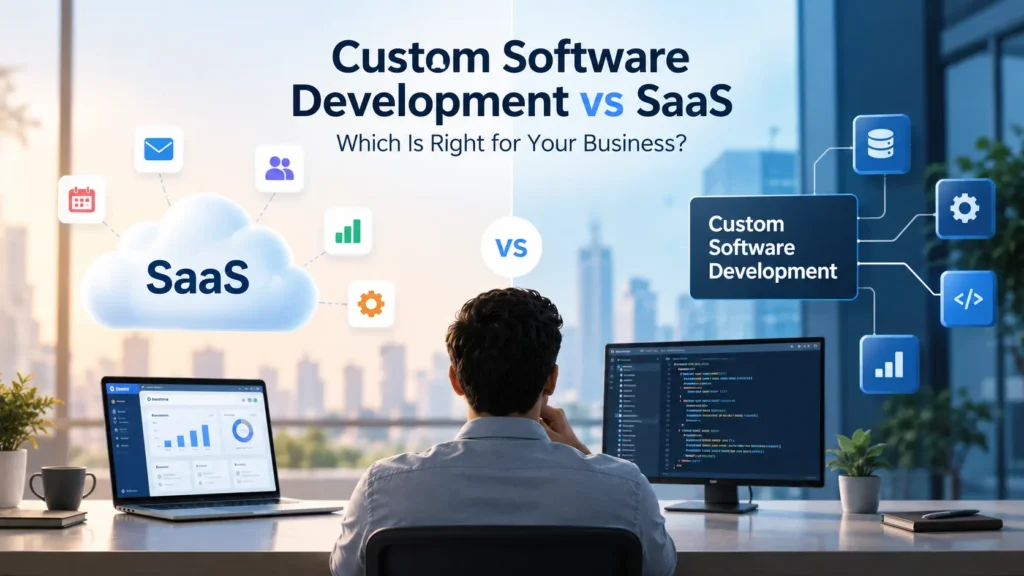
Choosing business software is no longer simply a question of buying a tool and getting started. Businesses today have access to hundreds of SaaS platforms, automation tools, AI solutions, and ready-made applications. At the same time, custom software development has become more accessible for companies that need technology built around their specific processes.
This creates an important question:
Should your business use an existing SaaS solution, or invest in custom software development? The answer depends less on the size of your company and more on how your business operates.
If a SaaS product solves your problem effectively, there may be no reason to build from scratch. But if your processes, data, integrations, customer experience, or competitive advantage require something that standard software cannot provide, custom software can become a strategic investment. This guide explains the key differences between SaaS and custom software development and how to decide which approach makes sense for your business.
What Is SaaS?
SaaS, or Software as a Service, is software that is developed and managed by a provider and delivered to customers through the internet. Businesses typically pay a monthly or annual subscription to use the software.
Examples include CRM platforms, accounting software, project management tools, HR platforms, communication tools, and marketing applications. The biggest advantage of SaaS is speed. You do not have to design, build, host, and maintain the entire system yourself. You can subscribe, configure the platform, train your team, and start using it.
For many businesses, that is exactly what they need.
What Is Custom Software Development?
Custom software development means creating software specifically for the requirements of a particular business, team, product, or workflow. Instead of changing your processes to match an existing application, the software is designed around your processes.
A custom solution might include:
- A business management platform
- A customer portal
- An internal operations system
- A custom CRM
- A workflow automation platform
- A mobile application
- An API-driven business platform
- An AI-powered application
- A system that connects multiple existing tools
Custom software does not necessarily mean building everything from zero. A good development approach can combine existing technologies, APIs, cloud services, open-source components, and AI capabilities to create a solution that fits the business.
Custom Software Development vs SaaS: The Key Difference
The simplest difference is this: SaaS gives you a product. Custom software gives you a solution designed around your business.
With SaaS, you generally choose a platform and configure it. With custom software, you define the business problem, design the required workflow, and build the technology around it. Neither approach is automatically better. The right choice depends on the problem you are trying to solve.
| Factor | SaaS | Custom Software |
|---|---|---|
| Initial cost | Usually lower | Usually higher |
| Time to launch | Faster | Longer |
| Customisation | Limited to available options | High |
| Ownership | Provider-owned platform | Can be business-owned |
| Integrations | Depends on APIs/connectors | Can be designed specifically |
| Scalability | Provider-defined | Designed around your needs |
| Maintenance | Mostly handled by provider | Business/development partner |
| Control | Lower | Higher |
| Competitive differentiation | Limited | Stronger potential |
| Best for | Standard business needs | Unique or complex requirements |
The important point is that cost and speed should not be the only factors in the decision.
When SaaS Is the Better Choice
SaaS is often the right option when your business has a relatively standard requirement. For example, imagine a company needs:
- Basic project management
- Employee attendance
- Standard accounting
- Email marketing
- General CRM functionality
- Online collaboration
- Customer support ticketing
If an established SaaS platform already provides these capabilities, developing an alternative may not create enough additional value to justify the investment.
SaaS can make sense when:
1. You need to launch quickly
A ready-made platform can often be configured much faster than custom software can be developed.
2. Your requirements are standard
If your business process is similar to thousands of other companies, an existing platform may already solve the problem.
3. You want predictable operating costs
Subscription pricing can make budgeting easier, particularly for smaller businesses.
4. You do not want to manage the technology
The SaaS provider generally handles infrastructure, updates, maintenance, and much of the technical administration.
5. The software is not a competitive differentiator
If the tool simply supports your business rather than differentiating it, buying an established solution can be more practical.
In these situations, custom development can become unnecessary complexity.
When Custom Software Development Makes More Sense
Custom development becomes more attractive when your business does not fit neatly into standard software. Consider a company with a unique operational process involving multiple teams, complex approval rules, several third-party systems, and customer-specific workflows. A standard SaaS product might handle 70–80% of the requirement. The problem is what happens with the remaining 20–30%. Teams may start using spreadsheets, manual workarounds, emails, separate tools, or duplicate data entry. That is where the real cost can appear.
Custom software can make sense when:
1. Your workflow is unique
If your business has processes that directly contribute to your competitive advantage, forcing those processes into a generic platform may create unnecessary friction.
2. Multiple systems need to work together
Businesses often use CRM, ERP, accounting, HR, payment, communication, analytics, and customer-facing systems. Custom software can act as a connected layer between these systems.
3. You need deeper automation
If employees spend significant time moving information between systems, custom automation can potentially remove repetitive work.
4. You need greater control over data
Data ownership, access control, reporting, security, and integration requirements can become important as a business grows.
5. The software itself is part of your product
If technology is directly responsible for how you serve customers or generate revenue, owning more of that technology can become strategically important.
6. Existing SaaS products are forcing expensive compromises
If you are constantly paying for multiple tools, customising workarounds, or changing business processes just to fit software limitations, it may be time to reassess the approach.
The AI Factor: Custom Software Is Changing
AI is adding another dimension to the custom software vs SaaS decision. Many SaaS products now include AI features. For common use cases, this can be extremely useful. But businesses with unique data and workflows may want AI to work inside their own systems.
For example, a company could build software that uses AI to:
- Summarise customer conversations
- Classify support requests
- Extract information from documents
- Predict operational issues
- Recommend next actions
- Search internal business knowledge
- Automate repetitive decisions
- Generate reports
- Assist employees with internal workflows
The value is not simply “adding AI.” The real opportunity is connecting AI with business data + business rules + business workflows. That is where custom software can provide an advantage. Instead of giving employees another AI tool, a business can integrate AI directly into the applications they already use.
Don’t Build Custom Software Just Because You Can
There is also a trap on the other side. Custom software is not automatically the better option. Building a system simply because you want complete control can result in unnecessary development costs, maintenance responsibilities, security risks, and technical complexity.The question should not be:
“Can we build this ourselves?” The better question is:
“Will building this create enough business value to justify the investment?” Before starting development, identify the problem, quantify its impact, and understand what a successful outcome looks like.
Start With the Business Problem
Before discussing programming languages, cloud platforms, AI models, or application architecture, document how the business works today.
Ask:
- Where does the process begin?
- Who is involved?
- Where are approvals required?
- Which systems are used?
- Where is information entered?
- Where does duplicate work happen?
- Where do errors occur?
- What information is difficult to find?
- Which tasks are still handled manually?
- What slows customers or employees down?
This exercise often reveals something important. The business may not actually need “new software.” It may need better-connected software. A well-designed integration or automation layer can sometimes solve the problem without replacing existing systems.
Think About Integration Before Features
Modern businesses rarely run on a single application. Your CRM may need to communicate with your ERP. Your website may need to connect with your CRM. Your application may need payment processing. Your support system may need customer information. Your AI assistant may need access to internal knowledge. That makes integration a major part of the software decision.
Before selecting SaaS or custom development, map:
Systems → Data → APIs → Workflows → Users
This helps you understand whether an existing SaaS ecosystem is sufficient or whether a custom solution would provide better control.
Consider the Total Cost, Not Just the Initial Cost
One of the biggest mistakes businesses make is comparing SaaS subscription cost with custom development cost and stopping there. The real comparison should include the total cost of ownership.
For SaaS, consider:
- Subscription fees
- Number of users
- Premium features
- Integration costs
- Data migration
- Customisation
- Vendor price increases
- Multiple tools required to fill gaps
For custom software, consider:
- Development
- Cloud infrastructure
- Security
- Maintenance
- Support
- Future enhancements
- Monitoring
- Development team or technology partner
A solution that appears cheaper initially may become expensive over several years. Likewise, a custom system with a large upfront investment may create significant savings or revenue opportunities over time.
Security and Data Ownership Matter
Security should not be treated as a final checklist item.
Before choosing a software approach, understand:
- Where business data is stored
- Who can access it
- How user permissions work
- How backups are managed
- How data is transferred
- How integrations are secured
- What happens if you leave the platform
- Who owns your data
- What happens to your data if the vendor changes its product
With custom development, businesses also need to clarify ownership of source code, infrastructure, credentials, domains, APIs, databases, and third-party accounts. Clear ownership reduces long-term dependency.
Think About the People Using the Software
Technology projects do not fail only because of technical problems.They can also fail because employees do not want to use the new system. A technically impressive application is not useful if employees find it confusing or if it adds more work to their day.
1.Involve actual users early.
2. Show them prototypes.
3. Test real workflows.
4. Collect feedback.
5. Measure adoption after launch.
The goal is not to deploy software. The goal is to improve the way people work.
A Practical Decision Framework
If you are unsure whether to choose SaaS or custom software, ask these seven questions:
1. Is the problem standard or unique?
If it is standard, start by evaluating SaaS.
If it is unique and strategically important, consider custom development.
2. How much flexibility do you need?
If configuration is enough, SaaS may work.
If your workflows require extensive changes, custom software may be more appropriate.
3. How important are integrations?
If you only need a few established integrations, SaaS may be sufficient.
If your business depends on complex data flows across several systems, custom development may provide more control.
4. Is the software part of your competitive advantage?
If not, buying may make more sense.
If technology directly influences how you compete, building may be worth considering.
5. How quickly do you need the solution?
If you need something immediately, SaaS has an obvious advantage.
If the business case justifies a longer development cycle, custom software becomes more viable.
6. What will the system look like three to five years from now?
Do not select software only for today’s requirements.
Think about users, transactions, locations, integrations, automation, data, and new products you may need in the future.
7. What happens if the software cannot keep up?
This is often the question businesses forget.
If your business changes faster than your software, will the platform support you—or become a constraint?
A Hybrid Approach Can Be the Best Answer
The choice does not always have to be SaaS or custom software.
A hybrid model can often deliver the best balance.
For example:
- Use a SaaS CRM
- Use an existing accounting platform
- Build a custom customer portal
- Connect systems through APIs
- Add custom workflow automation
- Introduce AI where it provides measurable value
This approach avoids rebuilding capabilities that already exist while allowing the business to customise the areas that matter most.
In many cases, this is a smarter technology strategy than replacing everything.
How Vextron Approaches Custom Software Development
At Vextron, we believe custom software should begin with the business problem—not the technology stack.
The first step is understanding your current processes, users, systems, challenges, and business goals.
From there, the solution can be designed around what actually needs to improve.
Depending on the requirement, that could mean:
- Custom web applications
- Mobile applications
- Business workflow automation
- API development and integration
- Cloud-based applications
- AI-powered software
- Customer portals
- Internal business platforms
- Modernisation of legacy applications
The objective is simple: build technology that makes the business work better.
Sometimes that means building custom software.
Sometimes it means integrating existing SaaS products.
And sometimes the best answer is a combination of both.
Final Thoughts
There is no universal winner in the custom software development vs SaaS debate. SaaS is often the right choice when you need a proven solution quickly and your requirements are relatively standard. Custom software becomes more attractive when your workflows are unique, integrations are complex, data and ownership matter, or technology itself is becoming part of your competitive advantage. The smartest decision is not to ask which technology is more advanced.
Ask which approach creates the best business outcome.
1. Start with the problem.
2. Understand the workflow.
3. Calculate the long-term cost.
4. Evaluate integrations and security.
5. Think about future growth.
6. Then choose the technology approach that fits.
Because good software is not about having more features. It is about helping your business do more with less friction.